.jpg)
Despite the war, Ukraine’s retail real estate market continues to develop. New retail properties are emerging in relatively safe regions, retail parks have become the most dynamic format, and international brands are not only considering Ukraine but are also preparing to enter the market. At the same time, location quality, the right format, and professional property management are becoming increasingly important for developers.
In an interview with Polish industry publication Retailnet.pl, Andrii Lototskyi, CEO of Retail & Development Advisor (RDA), spoke about how the company became Pepco’s exclusive representative in Ukraine, which international brands are currently interested in the Ukrainian market, where the greatest potential for new retail real estate development lies, and why retail parks have become one of the key formats during wartime. He also explained why RDA is expanding into shopping centre management and how he sees the market developing over the next five to seven years. RAU has prepared the key takeaways from the interview.
About RDA
RDA was established 13 years ago and has since evolved from a small brokerage company into one of the market leaders in providing comprehensive support for commercial real estate projects. We can support a project at virtually every key stage — from location research and concept development to brokerage, launch, and subsequent management of the retail property.
A particularly important milestone for us was 2023. Together with the founders, we reviewed our strategy and identified the areas and regions on which we should focus. Despite the war, the team remained in Ukraine and believed in the country’s development prospects. Over the past several years, we have consistently strengthened our position in Ukraine’s retail real estate consulting market.
How RDA Managed to Convince the Polish Retail Chain Pepco to Enter the Ukrainian Market Amid a Full-Scale War
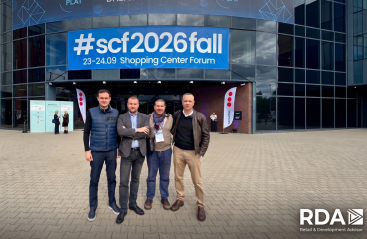
This was not the result of a single decision or a single meeting. We have been communicating with international retailers for many years at industry forums and exhibitions, presenting the Ukrainian market to them and explaining its prospects.
Our reputation also plays an important role. When an international brand considers a partnership, it looks not only at the potential of the country but also at the partner who will represent its interests in the local market.
In this case, a combination of factors came together: many years of working with international companies, a strong understanding of the Ukrainian market, and the results of our projects. I often say: the best work with the best — it is simply natural. We are also currently in discussions with several other international brands. Some have already decided to develop their businesses in Ukraine and are preparing to enter the market, while others are still assessing the situation.
We support them throughout this process: we arrange visits to Ukrainian shopping centres, regularly provide market analytics, organise meetings with potential partners, and help them better understand the specifics of the Ukrainian retail market.
What Factors Do International Brands Consider Today When Deciding Whether to Enter or Expand in Ukraine
Large international brands look not only at the current situation but also at the long-term outlook. We expect that once the war ends, Ukraine’s retail and retail real estate markets will develop much more dynamically. Competition for high-quality retail space will increase, and rental rates will rise accordingly.
Moreover, every international brand that is already operating successfully in Ukraine effectively becomes a promoter of our market to other companies. When a major international retailer demonstrates a positive experience of operating in Ukraine, this becomes an additional argument for others.
Our task is to demonstrate the market’s real potential and help brands properly assess and mitigate wartime risks.
Common Mistakes Foreign Retailers Make When Entering the Ukrainian Market
The most common mistake is overconfidence, insufficient flexibility, and an unwillingness to adapt a global business model to local conditions. The Ukrainian market has its own specifics, and what works very well in other countries will not necessarily work here without adaptation.
That is why it is very important to have a local partner who understands the market, consumers, developers, and tenants. I would advise international companies to work with consultants who can demonstrate their expertise not through words but through specific successfully completed projects.
The Current State of the Ukrainian Retail Real Estate Market
The market today is highly heterogeneous. New properties are primarily opening in relatively safe regions where internal migration has increased the population and created additional demand for quality retail infrastructure.
At the same time, there are currently very few large shopping centre projects. Most developments are small and medium-sized shopping centres, as well as retail parks. These formats are more attractive to developers because they require lower investment volumes, have shorter development timelines, and potentially offer faster returns on investment.
This is not merely a forced response to economic and wartime realities but also part of a broader European trend.
Small and medium-sized neighbourhood shopping centres are also actively developing, particularly within residential complexes built around the “city within a city” concept. Their main advantage is proximity to consumers. People do not always want to travel across the city for everyday purchases. If essential goods and services are available within a 10–15-minute walk from home, this creates stable local foot traffic.
Cities with the Greatest Potential for Modern Retail Real Estate Development
First and foremost, I would highlight the western regions — Zakarpattia, Ivano-Frankivsk, Lviv, and Chernivtsi regions.
Several factors come into play here: a relatively favourable security situation, population growth in some cities driven by internal migration, residential development, and a shortage of modern retail space.
However, I would not limit the assessment to geography alone. Even in a promising city, it is possible to develop an unsuccessful shopping centre if the location or format is chosen incorrectly.
The Decision to Expand into Shopping Centre Management
It was a completely logical step. Today, many developers who build shopping centres do not have sufficient experience in their subsequent operation and management. This issue is particularly acute in the regions, where there are relatively few professional managers with specific retail real estate experience.
At the same time, the quality of management has a direct impact on a shopping centre’s success: its occupancy rate, tenant mix, foot traffic, relationships with tenants and, ultimately, the capitalisation of the asset itself.
That is why we decided to offer the market not only consulting and brokerage services but also ready-made expertise in retail real estate management.
What Advantages Does a Developer Gain by Outsourcing Management
RDA currently manages five shopping centres. The main advantage for a developer that outsources management is access to an established team with real market experience.
Today, it is quite difficult to find managers who simultaneously have the necessary expertise, experience, and established relationships with retailers. Each of our properties has a dedicated manager, but that person works in synergy with the entire RDA team.
This allows us to leverage the company’s expertise as a whole rather than depend on the capabilities of a single individual.
For a developer, this also means reduced operational and staffing risks. They do not need to build a team from scratch, deal with its administration, replace employees, or gradually build up the necessary expertise. Instead, they gain access to a ready-made professional management system.
How Do You See the Development of Ukraine’s Retail Real Estate Market Over the Next 3–5 Years
Smaller formats and retail parks will continue to develop actively. But there is an important nuance here: it is not advisable to blindly follow the overall trend. Even today, we can see individual districts where an oversupply of retail space may emerge within the next two to three years.
Therefore, location quality, analysis of the competitive environment, and the right choice of format will become even more important.
At the same time, over the longer term — on a five-to-seven-year horizon — I expect international funds and institutional investors to enter the market. If this capital flows into Ukraine actively after the war ends, we could see a new wave of development of large regional shopping centres.
Overall, I am quite optimistic about the Ukrainian market. Demand for high-quality retail real estate has not disappeared. On the contrary, it is building up. Once the security situation stabilises, we may see a very active period of market development.
But those who simply build more square metres will not necessarily be the ones who succeed. Those who understand consumers better, choose the right location, create a strong concept, and ensure professional property management will be better positioned to succeed.
This is precisely what we are building our further strategy for RDA around.